

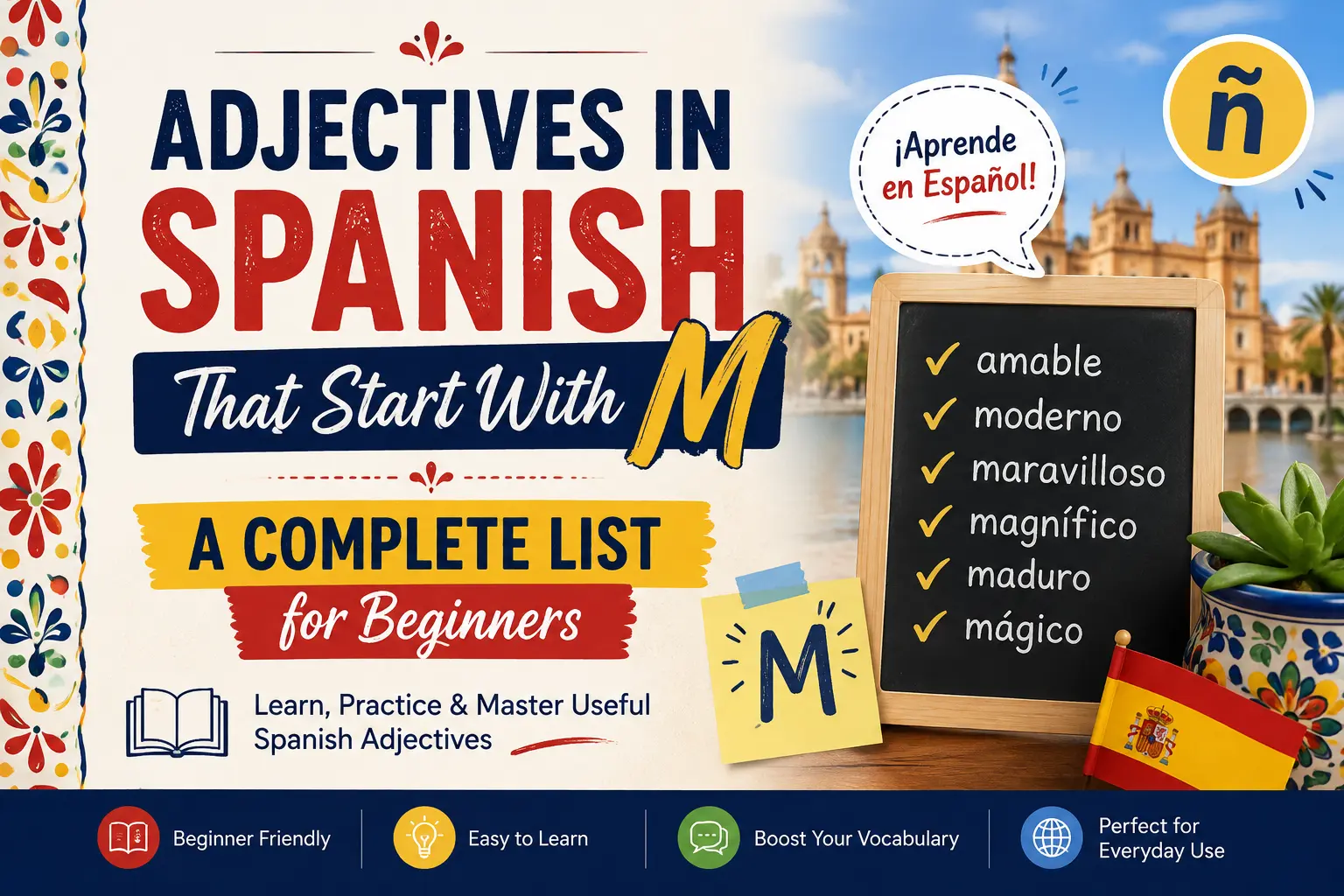
I still remember the first time I tried to describe my Spanish neighbor’s dog to a friend back home. I wanted to say it was “moody” — and I froze. I didn’t know a single Spanish adjective starting with M at the time. That gap sent me down a rabbit hole of flashcards, bad pronunciation attempts, and eventually, a list I now keep pinned above my desk. This article is that list, cleaned up and expanded for you.
If you’re learning Spanish, letter M is actually a goldmine. It gives you common describing words, a bunch of everyday nouns, and even a handful of Spanish city names. So let’s get into it — no fluff, just the words you’ll actually use.
Quick Answer: The Most Useful M Adjectives
If you only have two minutes, here are the ones worth memorizing first:
- Malo/a — bad
- Mayor — older, bigger
- Menor — younger, smaller
- Moreno/a — dark-haired, tan
- Maravilloso/a — wonderful
- Molesto/a — annoying, bothered
- Mojado/a — wet
- Maduro/a — mature, ripe
These eight alone will get you through most casual conversations. Now let’s expand the full list.
Full List: Adjectives in Spanish That Start With M
Spanish adjectives usually change ending based on gender — the “o” version is masculine, “a” is feminine. I’ve marked that where it applies.
| Spanish | English | Example |
|---|---|---|
| Malo/a | Bad | El café está malo hoy. (The coffee is bad today.) |
| Mayor | Older / elder | Mi hermano mayor vive en Madrid. |
| Menor | Younger / minor | Ella es la menor de la familia. |
| Mejor | Better / best | Este plan es mejor. |
| Moreno/a | Dark-haired, tan | Tiene el pelo moreno. |
| Molesto/a | Annoyed, annoying | Estoy molesto contigo. |
| Mojado/a | Wet | La ropa está mojada. |
| Maravilloso/a | Wonderful | Fue un día maravilloso. |
| Maduro/a | Mature, ripe | El plátano está maduro. |
| Manso/a | Tame, gentle | El perro es muy manso. |
| Mareado/a | Dizzy | Me siento mareado. |
| Mentiroso/a | Lying, dishonest | No confío en él, es mentiroso. |
| Miedoso/a | Fearful | Mi gato es un poco miedoso. |
| Mínimo/a | Minimal | El riesgo es mínimo. |
| Mismo/a | Same | Tenemos el mismo problema. |
| Moderno/a | Modern | Su casa es muy moderna. |
| Modesto/a | Modest | Es un hombre modesto. |
| Múltiple | Multiple | Hay múltiples razones. |
| Musical | Musical | Tiene un talento musical. |
| Mundial | Worldwide | Es un problema mundial. |
| Materno/a | Maternal | El amor materno es fuerte. |
| Metálico/a | Metallic | El color es metálico. |
| Migratorio/a | Migratory | Es un ave migratoria. |
| Milagroso/a | Miraculous | Fue una recuperación milagrosa. |
| Miserable | Miserable | Se sentía miserable. |
That’s twenty-five right there, and honestly, you don’t need to learn them all at once. I’d suggest picking five a week and actually using them in a sentence about your own day. That’s what made them stick for me — not the flashcard app, but forcing myself to describe real things.
Bonus: Other Spanish Words That Start With M
Since a lot of people searching for adjectives are really just looking for spanish words that start with m in general, here’s a broader mix — nouns and a few common phrases you’ll bump into constantly.
- Mesa — table
- Mano — hand
- Madre — mother
- Mercado — market
- Mañana — morning / tomorrow
- Mundo — world
- Mujer — woman
- Museo — museum
- Miedo — fear
- Música — music
Notice how many of these show up in beginner textbooks in the first month of class? That’s not a coincidence — M words are frequent in everyday Spanish, which is partly why this letter gets searched so much.
Places in Spain Starting With M
A slightly different angle, but one people often want alongside vocabulary lists: Spanish cities and regions starting with M.
- Madrid — the capital
- Málaga — coastal city in Andalusia
- Murcia — southeastern region
- Mallorca — island in the Balearics
- Marbella — beach town near Málaga
- Menorca — another Balearic island
If you’re planning a trip or just building cultural context around the language, knowing these names helps the vocabulary feel less abstract. I found that learning place names alongside adjectives actually helped me remember both better — “Madrid es moderna” sticks in a way that isolated word lists never do.
How to Actually Remember These Words
Here’s the honest bit: memorizing a list rarely works long-term. What worked for me was pairing each adjective with something personal. For “mojado” (wet), I pictured my shoes after a rainy walk in Barcelona. For “mentiroso,” I thought of a specific character from a telenovela I was watching to practice listening. It sounds silly, but attaching a mental image or memory to each word beats rote repetition every time.
One caveat, though — don’t rely only on lists like this one. They’re a great starting point, but real fluency comes from hearing these adjectives used in context: podcasts, shows, conversations with native speakers. A list gets you the raw material; conversation is where it actually becomes usable.
A Small Grammar Note
Spanish adjectives usually come after the noun, which trips up a lot of English speakers. You’d say “un perro manso” (a tame dog), not “un manso perro.” There are exceptions — a handful of adjectives can go before the noun for emphasis or tone — but as a beginner, stick with the noun-then-adjective order and you’ll sound natural almost every time.
Final Thoughts
Letter M turns out to be one of the more rewarding letters to study in Spanish — practical adjectives, everyday nouns, and recognizable place names all in one place. Keep this list handy, but don’t stop here. Try building two or three sentences a day using a fresh word from it. That’s genuinely how it clicked for me, and I suspect it’ll work for you too.
FAQs
1. What are some common adjectives in Spanish that start with M?
Some of the most common ones are malo/a (bad), mayor (older), moreno/a (dark-haired), maravilloso/a (wonderful), and mojado/a (wet).
2. Do Spanish adjectives starting with M change based on gender?
Yes, many do. Adjectives ending in “-o” become “-a” for feminine nouns, like moreno/morena or maduro/madura. Some, like “mejor” or “mundial,” stay the same for both genders.
3. What is the Spanish word for “bad” starting with M?
“Malo” (masculine) or “mala” (feminine) means bad in Spanish.
4. Are there Spanish words that start with M besides adjectives?
Definitely. Common nouns include mesa (table), mano (hand), madre (mother), and mercado (market).
5. What places in Spain start with the letter M?
Madrid, Málaga, Murcia, Mallorca, Marbella, and Menorca are well-known examples.
6. How many adjectives in Spanish start with M?
There are dozens, but for everyday conversation, learning around 20-25 core ones (like the list above) covers most situations you’ll run into.
7. Is “mayor” always about age in Spanish?
Mostly, yes — it usually means “older” or “elder.” Context matters, though, since it can also relate to size or importance in certain phrases.
8. What’s the difference between “mejor” and “mayor”?
“Mejor” means “better,” while “mayor” means “older” or “bigger.” They’re easy to mix up for beginners, so it helps to practice them in separate sentences.
9. Can Spanish adjectives go before the noun?
Usually they come after the noun, but a few adjectives can go before for emphasis or a slightly different meaning. As a beginner, placing them after the noun is the safer default.
10. What does “moreno” mean in Spanish?
It typically describes someone with dark hair or a tan complexion, depending on regional usage.
11. Are these M words used in Latin American Spanish too, or just Spain?
Nearly all of them are used across Spanish-speaking countries. A few, like place names, are Spain-specific, but the adjectives and nouns are universal.
12. What’s a good way to memorize Spanish adjectives that start with M?
Pair each word with a personal image or memory instead of just repeating flashcards. Using the word in your own sentence about your day also helps it stick.
13. Is “mismo” an adjective in Spanish?
Yes, “mismo/a” means “same,” and it’s commonly used, e.g., “el mismo día” (the same day).
14. What does “molesto” mean, and how is it used?
It means “annoyed” or “annoying,” depending on context — “Estoy molesto” means “I’m annoyed,” while “Es molesto” means “It’s annoying.”
15. Where can I practice using these M adjectives in real sentences?
Language exchange apps, Spanish podcasts, and writing a short daily journal entry using 2-3 new words are all solid ways to move beyond memorization into actual use.