

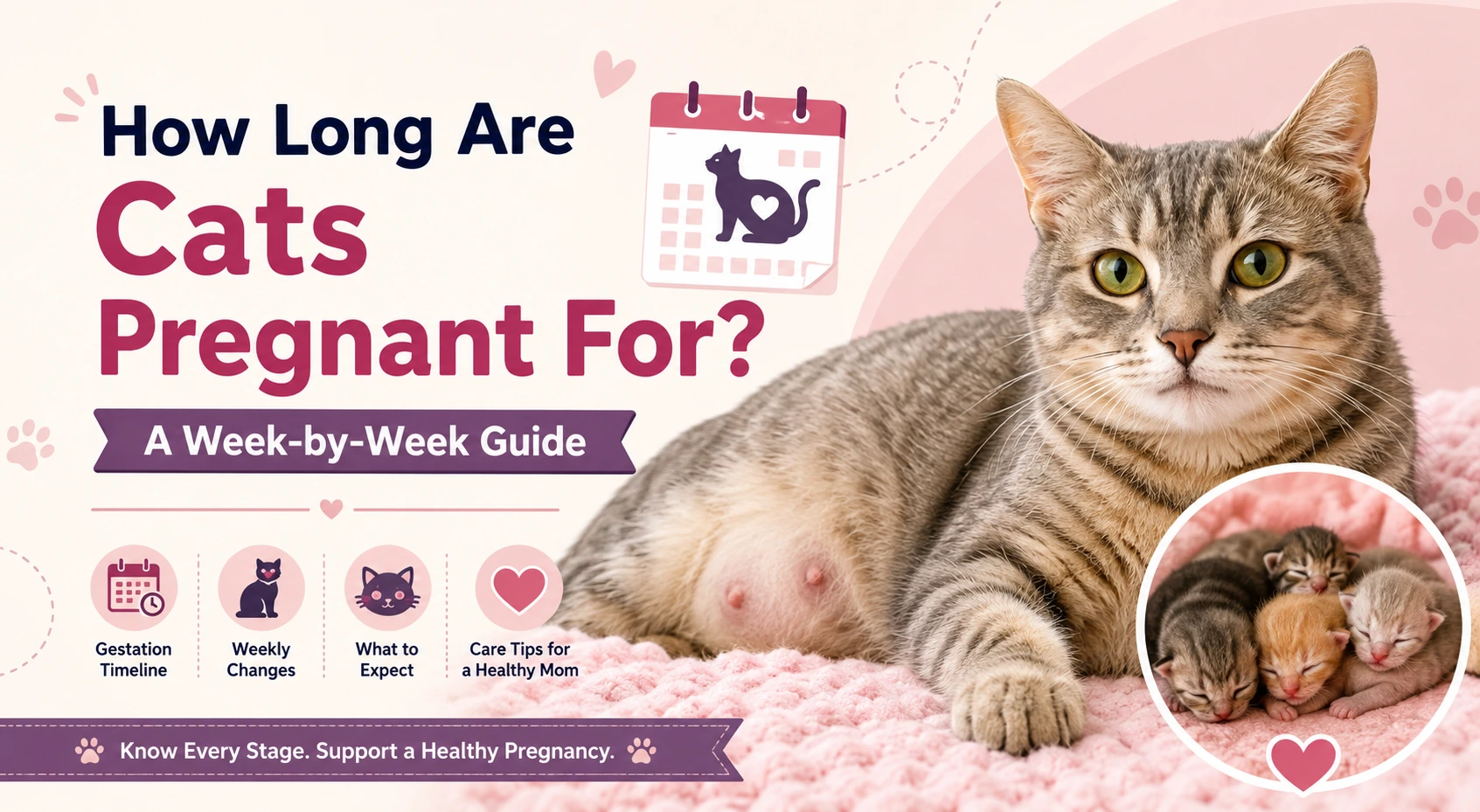
Quick Answer: How Long Are Cats Pregnant For?
Cats are pregnant for about 63 to 65 days, which works out to roughly nine weeks. Some litters arrive a few days early, some run a little late — anywhere from 61 to 72 days is still considered normal, though anything past 70 days is worth a vet check.
If you’ve just found out your cat is expecting, that’s the number to circle on your calendar. But nine weeks with a pregnant cat isn’t just a countdown — a lot changes week to week, and knowing what’s normal (and what isn’t) makes the whole thing a lot less stressful. I’ve fostered a litter through this exact timeline, and I can tell you the calendar math is the easy part. Reading your cat’s body language along the way is where it gets interesting.
Cat Pregnancy: Week by Week
Cat gestation moves fast compared to dogs or humans, which honestly catches a lot of first-time cat owners off guard. Here’s roughly what happens at each stage.
Week 1–2: Fertilization and Early Development
Nothing visible happens yet. The eggs are fertilized and starting to travel toward the uterus, but your cat will look and act completely normal. If you didn’t witness the mating, this stage is genuinely impossible to detect just by looking at her.
Week 3: The First Physical Sign
This is usually when owners notice something’s off. Her nipples start turning pink and slightly swollen — vets call this “pinking up.” It’s one of the earliest reliable signs of pregnancy in cats, often more noticeable than any change in appetite or behavior at this point.
Week 4: Morning Sickness (Yes, Cats Get It Too)
Some cats go through a mild version of morning sickness around this time — a bit of vomiting, reduced appetite, maybe some lethargy. It usually passes within a few days. If it doesn’t, or if she stops eating entirely, that’s worth a vet call rather than waiting it out.
Week 5: Weight Gain Begins
By now her belly is starting to round out, and a vet can usually confirm pregnancy through gentle palpation or an ultrasound around this stage. This is also roughly when I’d suggest switching her food if you haven’t already — kittens need more calories and protein than she’s used to eating.
Week 6: The Belly Becomes Obvious
There’s no missing it now. Her abdomen is visibly larger, and depending on litter size, you might even notice movement if you watch closely while she’s resting. Her appetite typically increases noticeably around this point too.
Week 7: Nesting Behavior Starts
This is where personality really shows. Some cats start hunting for quiet, enclosed spaces — closets, under beds, the back of a wardrobe. Others get unusually clingy, following you room to room. My own foster cat did both, depending on the day, which honestly made her feel a bit like a moody teenager.
Week 8: Getting Close
Her belly is at its largest, movement is much easier to feel, and she’ll likely slow down significantly. This is a good time to set up a proper nesting box in a quiet spot, lined with soft towels, and get her used to it before she goes into labor.
Week 9: Labor Is Near
In the final days, look for restlessness, pacing, a drop in appetite, and possibly some vocalizing. Her body temperature typically drops slightly in the 24 hours before labor starts, though most owners won’t be tracking that unless specifically advised to by a vet.
How Long Do Cats Stay Pregnant, Really?
The textbook number is 63 to 65 days from the day of mating, but here’s the honest complication: most owners don’t know the exact mating date, especially with outdoor or recently adopted cats. That’s where an early vet visit really pays off — ultrasounds around week 3 to 4 and palpation can help estimate how far along she is even without a known start date.
Litter size can shift things slightly too. Cats carrying a larger litter sometimes deliver a touch earlier, while smaller litters can occasionally run a bit longer. It’s not a hard rule, just a pattern vets commonly see.
What Affects How Long a Cat Is Pregnant?
A few factors can nudge the timeline slightly in either direction:
- Breed — Some breeds, like Siamese, have a reputation for slightly shorter gestation compared to others, though the difference is usually just a day or two.
- Litter size — Larger litters can sometimes arrive a bit earlier.
- First-time vs. experienced mothers — First litters occasionally run a touch longer, though this isn’t universal.
- Overall health and nutrition — A cat that isn’t getting proper nutrition during pregnancy may have a less predictable timeline and higher risk of complications.
None of these should shift the timeline by more than a few days. If you’re well past day 70 with no sign of labor, that’s not a “wait and see” situation — call your vet.
Signs Labor Is About to Start
In the last day or two, most cats show a fairly recognizable pattern:
- Restlessness and pacing
- Reduced appetite, sometimes refusing food entirely
- Frequent visits to the nesting spot
- Excessive grooming, particularly around the belly and hind end
- Occasional soft vocalizing or clinginess
Once contractions start, the first kitten usually arrives within an hour. If she’s been actively straining for more than 30–40 minutes without producing a kitten, that’s an emergency, not something to monitor further at home.
A Few Things I Wish More Guides Mentioned
Most articles on this topic stop at the number 63–65 days and call it done. A couple of things worth knowing that don’t always make the list:
Not every pregnant cat shows obvious nesting behavior. Some just carry on almost normally until the last day or two, which can genuinely catch owners off guard if they’re expecting dramatic behavioral changes throughout.
Also, cats can technically be pregnant with kittens from more than one father in the same litter, since they can mate with multiple males during a single heat cycle. It doesn’t affect gestation length, but it does explain why kittens in the same litter sometimes look completely different from each other.
The Bottom Line
Nine weeks, give or take a few days — that’s the honest answer to how long cats are pregnant for. The calendar math is straightforward, but the week-by-week changes are what actually tell you how she’s doing. Keep an eye on her appetite, her belly, and her behavior rather than just counting days, and loop in your vet for a confirmation ultrasound early on if you can. It takes the guesswork out of the back half of the pregnancy, which matters a lot once you’re getting close to delivery.
FAQs
1. How long are cats pregnant for?
About 63 to 65 days on average, roughly nine weeks from mating to delivery.
2. How long is a cat pregnant compared to a dog?
Cats have a shorter gestation than most dog breeds, which typically run around 63 days as well, though cats tend to be slightly more consistent within that range.
3. How can I tell if my cat is pregnant?
Early signs include pink, swollen nipples around week 3, mild appetite changes, and gradual weight gain from week 4 onward. A vet can confirm it via palpation or ultrasound.
4. How long do cats stay pregnant if it’s their first litter?
Generally the same 63–65 day range, though first-time mothers occasionally run a day or two longer.
5. Can a cat’s pregnancy last longer than 65 days?
Yes, up to around 70 days can still be normal. Beyond that, contact your vet.
6. When does a pregnant cat start showing?
Most cats show a visibly rounder belly by week 5 or 6.
7. How many kittens do cats usually have?
Litter sizes typically range from 1 to 6 kittens, with 4 being fairly average, though it varies by breed and the mother’s age.
8. What should I feed my pregnant cat?
Switching to a kitten-formula food (higher in protein and calories) from around week 4 or 5 is commonly recommended, but confirm the right approach with your vet.
9. How do I know when my cat is close to labor?
Restlessness, nesting behavior, reduced appetite, and a temperature drop in the final 24 hours are the main signs.
10. Can I tell how many kittens my cat is carrying?
An ultrasound can often estimate litter size from around week 5–6 onward, though an X-ray later in pregnancy (once skeletons calcify) is more accurate for counting.
11. Is it normal for a pregnant cat to still be active?
Yes, especially in the first two-thirds of pregnancy. Activity naturally decreases as she gets closer to delivery.
12. What if my cat isn’t nesting at all?
Some cats simply don’t show strong nesting behavior. It’s not necessarily a red flag as long as her appetite, weight gain, and overall behavior seem normal.
13. How long is labor itself once it starts?
Delivering a full litter can take anywhere from a few hours to around a day, with kittens usually arriving 30–60 minutes apart.
14. Should I take my cat to the vet during pregnancy?
Yes, at least one check early on to confirm pregnancy and estimate timing, plus another closer to delivery is generally a good idea.
15. What if my cat is straining but not delivering?
If she’s actively straining for more than 30–40 minutes without a kitten appearing, treat it as an emergency and contact your vet immediately.