

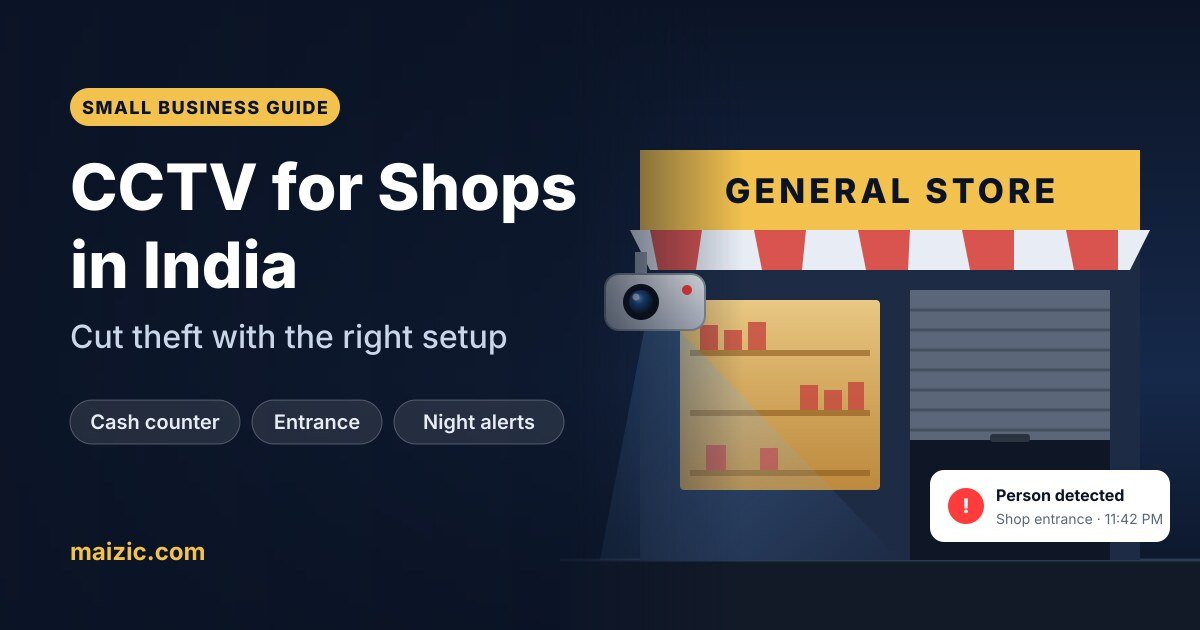
For a small shop owner in India, every missing item hurts. A few packets lifted from a shelf, a short cash drawer at closing time, or a break-in at night can wipe out a whole week’s profit. Most owners know they “should” have CCTV, but many either don’t have it or have a setup that doesn’t actually help when something goes wrong.
This guide is for kirana stores, mobile and electronics shops, medical stores, boutiques and small showrooms. It explains where cameras should go, what kind to buy, and how to use them so they actually reduce losses.
Why a CCTV setup pays for itself
- Prevents shoplifting: visible cameras alone discourage many people from trying.
- Settles cash disputes: you can check the counter footage instead of arguing with staff or customers.
- Protects at night: alerts on your phone if someone enters after closing.
- Helps with police and insurance: clear video is the strongest proof you can give.
- Lets you manage remotely: check the shop while you’re at the wholesale market or at home.
The 4 places every shop needs a camera
- Cash counter: point the camera at the drawer and the customer side of the counter. This is where most disputes happen.
- Entrance: capture every face coming in and going out, at eye level if possible.
- Main aisle or display area: where high-value or small, easy-to-pocket items are kept.
- Outside the shutter: for night-time protection when the shop is closed.
Choosing the right type of camera
WiFi cameras work well inside the shop if you have stable internet. They’re easy to install and you can watch them on your phone.
4G SIM cameras are better if your shop has no broadband or the connection drops often. They work on a regular mobile data SIM.
Multi-lens cameras are useful in small shops with limited wall space. One device with two or three lenses can watch the counter and the aisle at the same time. Ranges like Maizic SuperCams are built around this idea.
Outdoor weatherproof cameras are needed for the shutter and street side. Look for colour night vision so you can identify faces and vehicles after dark.
Features worth paying for
- Colour night vision: most break-ins happen at night.
- AI human detection: alerts only when a person moves, not for cats or passing headlights.
- Two-way audio and siren: lets you warn someone immediately from your phone.
- Memory card + cloud backup: if someone takes the camera, you don’t lose the footage.
- Multi-user app access: partners or family members can check in too.
Common mistakes shop owners make
- Mounting cameras too high, so you see only the top of people’s heads.
- Pointing a camera directly at the glass door, where bright daylight makes faces dark.
- Never checking whether recording is actually working until something happens.
- Turning on every alert, getting annoyed, and switching them all off.
A simple setup for most small shops
- 1 camera over the cash counter
- 1 multi-lens or 360° camera covering the entrance and main aisle
- 1 outdoor camera with night vision and a siren facing the shutter
Set motion alerts for after-closing hours only, and check a few minutes of recordings once a week to make sure everything is working.
For shops, offices and small businesses, you can compare indoor, outdoor and multi-lens options on the Maizic business security range.
The bottom line
CCTV isn’t only about catching thieves. It’s about running your shop with fewer losses, fewer arguments and more peace of mind. Three well-placed cameras, the right type for your internet situation, and sensible alerts are enough for most small shops in India.
Explore home and business security cameras at Maizic Smarthomes.