

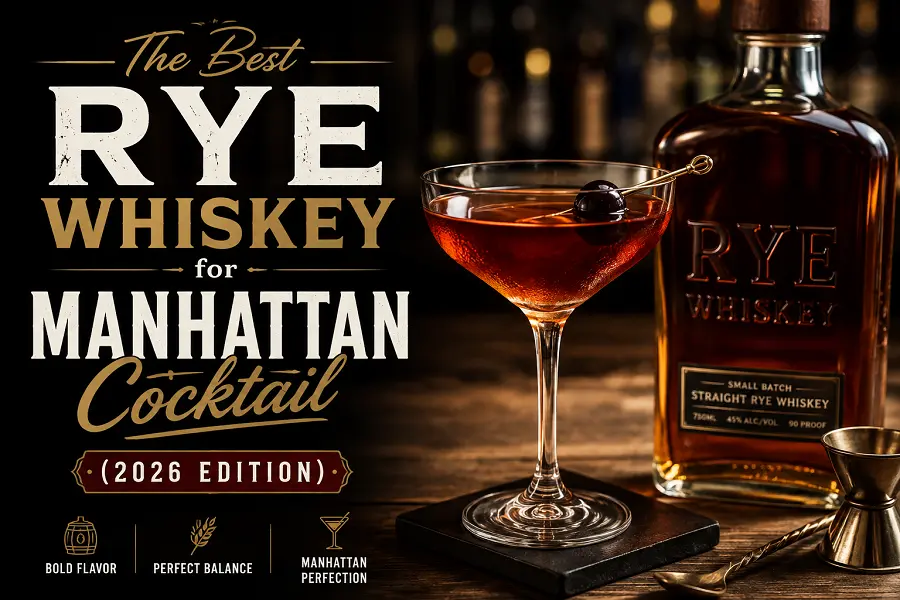
If you’ve ever ordered a Manhattan at a decent bar and thought, “why does this taste so much better than the one I made at home?” — the answer is usually the whiskey. Not the vermouth, not the bitters, not the stirring technique. The whiskey does most of the heavy lifting in this drink, and rye is what gives it that backbone bourbon just can’t match.
So let’s get straight to it: the best rye whiskey for a Manhattan cocktail right now is Rittenhouse Rye 100 Proof. It’s affordable, it’s got enough spice to stand up to sweet vermouth, and bartenders have been reaching for it for decades for good reason. But it’s not the only good option, and depending on your budget or your taste, another bottle might actually suit you better. I’ll walk through the ones worth your money below.
Why Rye Instead of Bourbon for a Manhattan?
A Manhattan is basically whiskey, sweet vermouth, and a couple dashes of bitters, stirred and strained. That’s it. Three ingredients, no hiding place. This is exactly why the whiskey you choose matters so much more here than it does in, say, a whiskey sour loaded with citrus and sugar.
Bourbon is sweeter and rounder by nature — corn-forward, softer on the tongue. Sweet vermouth is also sweet. Put the two together and you can end up with a drink that tastes flat, almost syrupy, without much to grab onto. Rye, on the other hand, is built on a higher percentage of rye grain, which brings peppery, dry, slightly bitter notes. That spice cuts through the vermouth instead of piling sweetness on sweetness. It’s the difference between a drink that feels balanced and one that feels like dessert.
This isn’t just my opinion, for what it’s worth — the original 1880s Manhattan recipes almost certainly called for rye, since bourbon wasn’t the dominant American whiskey style yet. Bourbon Manhattans became popular later, mostly because rye whiskey nearly disappeared during and after Prohibition. Rye has only fully come back into fashion over the last 15 years or so.
What to Actually Look For in a Manhattan Rye
Before jumping into specific bottles, it helps to know what separates a rye that works in this drink from one that gets lost in it.
Proof matters more than people think. Anything under 90 proof tends to disappear once you add vermouth and ice dilution. You want at least 90–100 proof so the whiskey still has a voice in the final glass.
Mash bill matters too. A “high-rye” rye (95%+ rye grain, like Rittenhouse or Sazerac) gives you more spice and dryness. A lower-rye mash bill (around 51–65% rye, blended with corn) softens things and leans a bit closer to bourbon in character — still good, just a different kind of good.
Age isn’t everything. A well-made 4-year rye can outperform an over-oaked 10-year in a mixed drink. Barrel-heavy, tannic whiskeys can actually clash with vermouth rather than complement it.
Best Rye Whiskeys for a Manhattan, By Category
Best Overall: Rittenhouse Rye (100 Proof)
Around $25–30 a bottle, and it’s genuinely hard to beat. Full proof, spicy, slightly sweet on the finish, and it holds its shape against sweet vermouth without fighting it. This is the bottle most professional bartenders keep behind the bar specifically for Manhattans, not as a compromise, but because it’s the right tool for the job.
Best Budget Option: Old Overholt (86 Proof)
It’s lower proof than I’d normally recommend, but at under $20, it’s the rye I tell people to start with if they’re not sure they’ll even like rye whiskey yet. Simple, a little grassy, gets the job done. Just don’t expect the same depth you’d get from something proofed higher.
Best Splurge: WhistlePig 10 Year
This one’s a genuine treat, and I’d save it for when you actually have time to sit and enjoy the drink rather than making it in a rush before guests arrive. Vermont-finished, rich, with a long caramel-and-spice finish. At $80+ it’s not an everyday bottle, but it makes a noticeably more complex Manhattan.
Best High-Proof Pick: Wild Turkey 101 Rye
101 proof, aggressive spice, and a price point most people can live with ($25–30). If you like your Manhattan to hit back a little, this is the one. Some people find it a touch rough neat, but mixed into a Manhattan, that roughness turns into character.
Best Underrated Pick: Sazerac Rye
Same distillery lineage as Buffalo Trace, and it flies under the radar compared to its bourbon siblings. Balanced, a bit of dried fruit, spicier than bourbon but smoother than some ryes. Solid mid-range choice around $25.
Best for a Softer Manhattan: Bulleit Rye
If straight rye feels too aggressive for your taste, Bulleit Rye’s lower rye content (95% corn/rye blend leaning less extreme than Rittenhouse) gives a gentler, slightly sweeter profile. Good bridge bottle for bourbon drinkers easing into rye Manhattans.
A Quick Story from Behind the Bar
I spent a few years bartending on and off, and Manhattans were one of those drinks that separated the regulars who knew what they wanted from the ones just ordering a “fancy whiskey drink.” One regular used to send back any Manhattan made with a soft, low-proof rye — not rudely, just a flat “this tastes watered down already.” He was right, honestly. Once we started defaulting to Rittenhouse for Manhattan orders, complaints like that basically stopped. It’s a small thing, but proof and mash bill really do change how the finished drink lands in the glass, not just on paper.
How to Build a Rye Manhattan the Right Way
- 2 oz rye whiskey
- 1 oz sweet vermouth (Carpano Antica or Dolin Rouge are both reliable)
- 2 dashes Angostura bitters
- Stir with ice for about 30 seconds — don’t shake, it bruises the texture and adds unwanted air bubbles
- Strain into a chilled coupe or rocks glass
- Garnish with a brandied cherry (Luxardo, if you can find it — the neon-red supermarket kind is a downgrade you’ll notice)
A 2:1 ratio (whiskey to vermouth) is the classic starting point. Some bars go 3:1 for a stronger, drier drink. There’s no wrong answer here — it comes down to whether you want the vermouth’s sweetness to be a supporting note or a co-lead.
A Fair Word of Caution
Not every “best rye whiskey” list is going to agree with this one, and that’s fine — palate is personal. If you genuinely prefer bourbon’s sweetness, there’s no rule that says you can’t make a bourbon Manhattan; plenty of great bars still serve it that way, often labeled a “Manhattan” with rye as the default and bourbon as a substitution. Also worth noting: pricier doesn’t always mean better for mixing. Some of the more expensive, barrel-proof ryes are honestly wasted in a Manhattan since their subtler notes get muted by the vermouth. Save those for sipping neat.
Final Take
If you want one bottle to buy today and stop overthinking it, get Rittenhouse Rye. It’s proven, affordable, and built for exactly this drink. If you want to experiment a bit, work your way through Wild Turkey 101 for something bolder or WhistlePig 10 Year for something smoother and more refined. The “best” rye whiskey for your Manhattan really depends on whether you like your drink spicy and dry, rich and rounded, or somewhere in between — and the only way to know for sure is to make a few and pay attention to what you reach for a second time.
Frequently Asked Questions
1. What is the best rye whiskey for a Manhattan cocktail?
Rittenhouse Rye 100 Proof is widely considered the best all-around choice because of its high proof and spicy profile that holds up well against sweet vermouth.
2. Can I use bourbon instead of rye in a Manhattan?
Yes. A bourbon Manhattan is a well-known variation, though it tends to taste sweeter and softer compared to the spicier, drier rye version.
3. What proof of rye whiskey works best for a Manhattan?
Aim for 90 to 100+ proof. Lower-proof ryes often get lost once mixed with vermouth and diluted by ice.
4. Is Rittenhouse Rye good for a Manhattan?
Yes, it’s one of the most commonly used bar-well ryes for Manhattans due to its balance of spice, proof, and affordability.
5. What’s the difference between rye and bourbon for cocktails?
Rye is spicier and drier because of its higher rye grain content, while bourbon is sweeter and rounder due to its corn-heavy mash bill.
6. What vermouth pairs best with rye whiskey in a Manhattan?
Carpano Antica Formula and Dolin Rouge are both popular choices; Carpano is richer and more herbal, Dolin is lighter and more approachable.
7. Should a Manhattan be shaken or stirred?
Stirred, always. Shaking adds unwanted air bubbles and slightly dilutes the drink more than intended, changing its texture.
8. What’s a good budget rye whiskey for a Manhattan?
Old Overholt is a solid budget-friendly option, typically under $20, though it’s lower proof than premium choices.
9. Is a higher-proof rye always better for a Manhattan?
Not necessarily “better,” but higher proof (90+) generally means the whiskey holds its character better once mixed and diluted.
10. What ratio of whiskey to vermouth should I use?
The classic ratio is 2:1 (whiskey to sweet vermouth), though some prefer 3:1 for a stronger, drier drink.
11. Can I use rye whiskey that’s aged 10+ years for a Manhattan?
Yes, though very old or barrel-proof ryes can sometimes be “wasted” in a mixed drink since subtler aged notes get muted by vermouth.
12. What garnish is traditional for a Manhattan?
A brandied cherry, ideally Luxardo, rather than standard maraschino cherries which are much sweeter and less complex.
13. Why does my homemade Manhattan taste watered down?
This usually happens when the rye is under 90 proof or the drink is over-stirred/over-diluted with ice.
14. Is Bulleit Rye a good choice for beginners?
Yes, its milder rye character makes it a good bridge for bourbon drinkers who aren’t ready for a spicier, high-rye whiskey.
15. What’s the best rye whiskey if I want a smoother, richer Manhattan?
WhistlePig 10 Year is a strong pick for a smoother, more refined Manhattan, though it comes at a higher price point.