

I spent three weekends mattress shopping last year, and by the end of it I could recite foam density numbers in my sleep — which, ironically, I still wasn’t getting much of. If you’ve landed here because you typed something like “make a table comparing memory foam vs hybrid mattresses” into Google at midnight, I get it. You just want the straight answer, not a sales pitch.
So let’s get into it.
The Quick Answer (Before You Read Further)
If you sleep hot, share a bed, or move around a lot at night, a hybrid mattress is usually the safer bet. If you sleep cold, live alone, or want that “sinking into a cloud” feeling with strong motion isolation, memory foam wins.
That’s the one-line version. Everything else below is the why.
What’s Actually Different Between Them?
A memory foam mattress is built from layers of viscoelastic foam, sometimes with a base layer of denser support foam underneath. There’s no metal, no coils — just foam, top to bottom.
A hybrid mattress, on the other hand, combines a foam or latex comfort layer on top with a pocketed coil support system underneath. You get some of that foam contouring, but the coils add bounce, airflow, and edge support that foam alone can’t really provide.
Think of it this way: memory foam is like a single instrument playing one note really well. A hybrid is more like a small band — each part is doing a slightly different job.
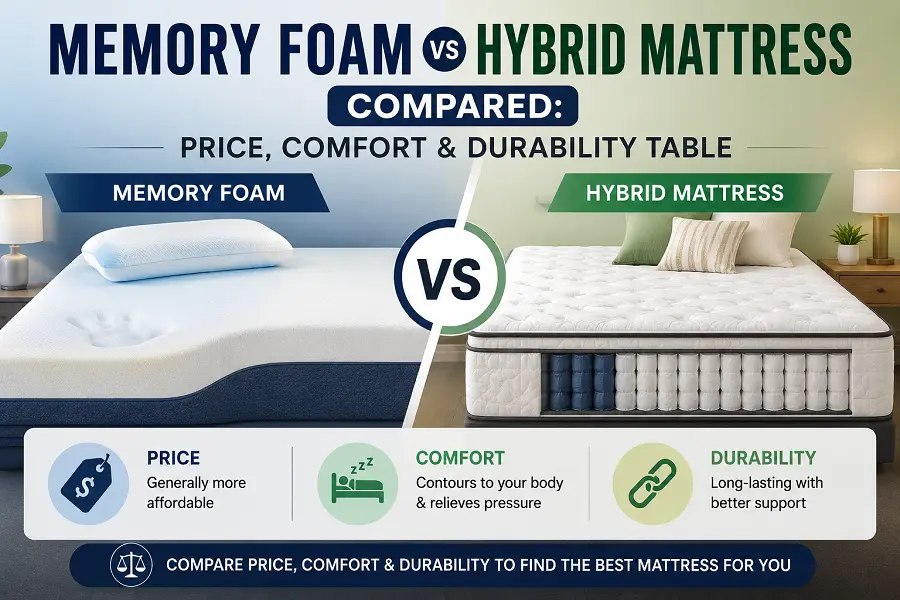
Memory Foam vs Hybrid Mattress: Full Comparison Table
Here’s the table you probably came here for. I’ve based this on average figures across mid-range to premium mattress brands, not one specific product.
| Feature | Memory Foam Mattress | Hybrid Mattress |
|---|---|---|
| Average Price Range | $600 – $1,800 (queen) | $900 – $2,500 (queen) |
| Comfort Feel | Deep contouring, slow “sink-in” | Balanced contour with bounce |
| Motion Isolation | Excellent | Good, but less than pure foam |
| Sleep Temperature | Tends to sleep warmer | Sleeps cooler due to coil airflow |
| Edge Support | Weak to moderate | Strong |
| Durability (avg. lifespan) | 7–10 years | 6–8 years |
| Best For | Side sleepers, couples wanting no motion transfer | Combo sleepers, back/stomach sleepers, hot sleepers |
| Weight | Heavier, harder to move | Even heavier due to coils |
| Break-In Period | 2–4 weeks | 1–3 weeks |
| Off-gassing Smell | More noticeable initially | Milder, less foam volume |
A quick note on that durability row — it surprises people. Pure memory foam, especially higher-density foam, actually tends to outlast hybrids in terms of years before sagging. Coils in a hybrid are durable too, but the comfort layer on top compresses a bit faster since it’s usually thinner than what you’d find in an all-foam bed.
Price: Where the Real Cost Difference Shows Up
Memory foam mattresses are generally cheaper to manufacture, which is why budget options are easier to find in that category. You can get a genuinely decent memory foam mattress for under $700.
Hybrids cost more because you’re paying for two separate systems — coils and foam — plus the engineering to make them work together without one wearing out faster than the other. Don’t assume higher price always means better quality, though. I’ve tested a $1,200 hybrid that felt worse than a $500 foam mattress from a smaller, lesser-known brand. Price is a signal, not a guarantee.
If budget is tight, foam usually gets you more mattress per dollar. If you’ve got some room to spend and sleep hot, the extra cost of a hybrid is often worth it.
Comfort: This Is Where Personal Preference Takes Over
Here’s something nobody tells you until you’ve actually tried both: comfort preference on this one is almost entirely about how you sleep, not which one is “objectively better.”
- Side sleepers often prefer memory foam because it cushions the shoulders and hips without pressure points.
- Back and stomach sleepers usually do better on hybrids, which keep the spine more level and don’t let the hips sink too deep.
- Couples — this one matters a lot. If your partner tosses and turns, memory foam absorbs that movement so you don’t feel it. Hybrids transfer a bit more motion because of the coil bounce.
My own experience: I switched from a hybrid to memory foam after my lower back started acting up, and the difference in morning stiffness was noticeable within about two weeks. That’s anecdotal, not medical advice — but it’s exactly the kind of trade-off you’re weighing here.
Durability: What Actually Wears Out First
Mattresses don’t fail all at once. They sag gradually, usually where you sleep most (the classic “body impression” problem).
With memory foam, high-density foam (5 lb/cu ft or higher) holds up noticeably longer than the cheaper 3 lb foams used in budget models. If you’re comparing two memory foam mattresses and one lists foam density, that’s a real quality signal worth checking.
With hybrids, the coil count and gauge matter, but so does the thickness of the comfort layer sitting on top. A hybrid with a thin 1-inch foam layer over coils will feel more like a traditional innerspring mattress within a couple of years, once that thin layer compresses.
Neither type is indestructible. Anyone telling you a mattress will “last forever” is selling something.
A Few Things the Table Doesn’t Show You
- Sleeping hot is a bigger deal than people expect. If you’ve ever woken up sweaty at 3 a.m., that’s usually foam trapping body heat. Gel-infused foams help a little, but they don’t fully solve it the way coil airflow does.
- Edge support matters more if you sit on the bed a lot — getting dressed, tying shoes, whatever. Hybrids hold up better here; foam edges tend to compress and feel unstable over time.
- New mattress smell (off-gassing) is normal, but it’s stronger with all-foam beds simply because there’s more foam volume releasing VOCs. Give it 24–72 hours in a ventilated room before judging the smell.
Memory Foam vs Hybrid: Quick Decision Guide
Ask yourself these three questions:
- Do I sleep hot? → Hybrid.
- Do I share a bed with a restless sleeper? → Memory foam.
- Am I on a tight budget? → Memory foam, generally.
If your answers point in different directions, that’s normal — most people end up compromising on one factor to get the other. There’s no universally “correct” choice here, just the right one for your specific sleep situation.
Final Take
Neither mattress type is better in some absolute sense — that’s marketing talk, not reality. Memory foam wins on pressure relief, motion isolation, and often price. Hybrids win on temperature control, edge support, and that more “traditional” mattress feel. If you can, test both in person for at least 10–15 minutes each before deciding, and don’t be afraid to use a brand’s trial period if they offer one. A mattress is one purchase where a 100-night trial matters more than any spec sheet.
FAQs
1. Is a memory foam or hybrid mattress better for back pain?
It depends on the type of back pain, but many people with lower back issues find hybrids helpful because they don’t let the hips sink too far, keeping the spine more aligned. Others with pressure-point pain prefer foam’s contouring.
2. Which lasts longer, memory foam or hybrid mattresses?
On average, high-density memory foam mattresses last 7–10 years, slightly longer than most hybrids at 6–8 years, mainly because the top comfort layer in hybrids compresses faster than the coil base wears out.
3. Do hybrid mattresses sleep cooler than memory foam?
Yes, generally. The coil layer in hybrids allows airflow underneath the comfort layer, which helps dissipate heat better than a solid block of foam.
4. Are hybrid mattresses worth the extra cost?
If you sleep hot, sit on the edge of the bed often, or want more bounce, yes. If none of that matters to you, a good memory foam mattress can offer similar comfort for less money.
5. What’s a good foam density for a memory foam mattress?
Look for at least 4–5 lb/cu ft density in the comfort layer. Anything below 3 lb tends to break down faster and lose support within a couple of years.
6. Do memory foam mattresses smell when new?
Yes, this is called off-gassing and is normal. It usually fades within a few days if the room is well-ventilated. It’s more noticeable in foam mattresses than hybrids simply due to foam volume.
7. Which is better for couples, memory foam or hybrid?
Memory foam generally isolates motion better, so if your partner moves a lot at night, foam will disturb your sleep less. Hybrids transfer slightly more motion due to the coil bounce.
8. Can I find a good memory foam vs hybrid mattress under $1,000?
Yes. Memory foam is easier to find at this price point since manufacturing costs are lower. Decent hybrids under $1,000 exist too, but you may need to check reviews carefully for coil quality.
9. Do hybrid mattresses have better edge support than memory foam?
Yes, generally. The coil system provides a firmer perimeter, making it easier to sit or sleep near the edge without feeling like you’ll roll off.
10. How long is the break-in period for a new mattress?
Most memory foam mattresses need 2–4 weeks to fully expand and soften to their intended feel. Hybrids usually settle faster, within 1–3 weeks.
11. Is memory foam bad for hot sleepers?
Not “bad,” but it does tend to retain more heat than hybrids. Gel-infused or open-cell foams help somewhat, but if overheating is a major concern, a hybrid is usually the more reliable choice.
12. What mattress type is best for side sleepers?
Memory foam tends to be preferred by side sleepers because it cushions pressure points at the shoulders and hips more effectively than firmer hybrid surfaces.
13. Do memory foam mattresses need a special base or frame?
Most work fine on a solid platform base, slatted frame (with slats spaced closely, usually under 3 inches apart), or adjustable base. Avoid frames with wide gaps, as foam needs even support.
14. Which is heavier to move, memory foam or hybrid?
Hybrids are generally heavier due to the steel coil layer, which can make them harder to rotate or move compared to all-foam mattresses.
15. How do I decide between memory foam and hybrid if I can’t test them in a store?
Check the brand’s trial period and return policy first — most reputable brands offer 90–100 night trials. Buying online without testing is common now, but a solid trial period protects you if the feel isn’t right.