

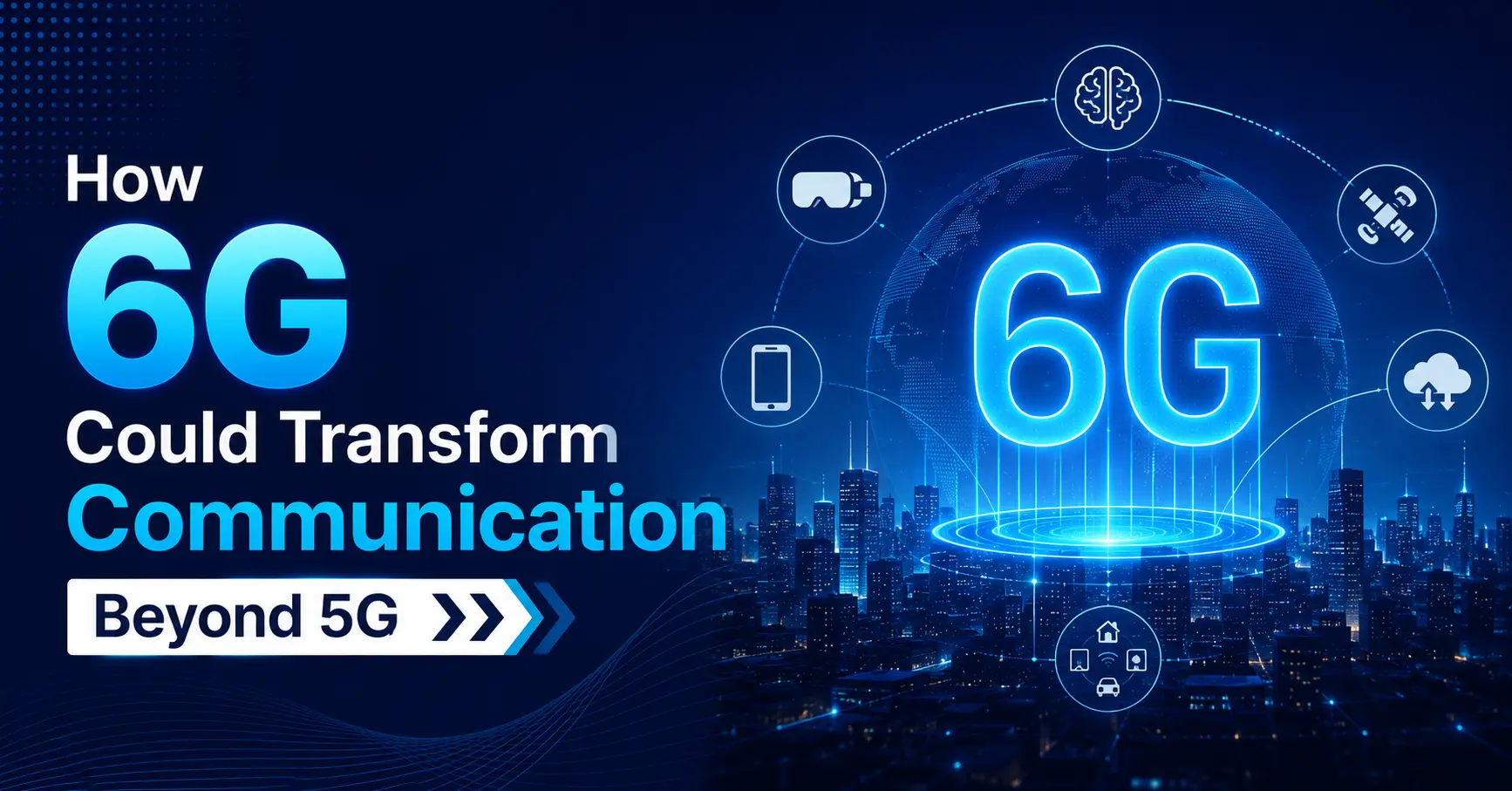
As 5G networks continue to roll out globally, the research community is already looking toward the next horizon: 6G. While 5G is currently optimizing how we stream, browse, and connect, 6G is being designed to fuse the physical and digital worlds into a single, seamless environment. Expected to reach commercial markets around 2030, this sixth-generation technology promises to be more than just a faster version of its predecessor; it represents a fundamental shift in how networks operate and support human activity.
Key Capabilities Driving the 6G Evolution
6G technology aims to address the limitations of current networks by pushing boundaries in speed, latency, and integration. It moves beyond simple data transmission to become an “intelligent fabric” that supports complex, real-time interactions.
-
Unprecedented Data Throughput: While 5G provides impressive speeds, 6G is expected to reach theoretical peaks of 1 terabit per second (Tbps), which is roughly 100 times faster than current 5G benchmarks.
-
Microsecond Latency: By reducing the delay between sending and receiving data to just a few microseconds, 6G will enable near-instantaneous responses, making remote operations feel identical to local control.
-
AI-Native Architecture: Artificial intelligence will be embedded into the very foundation of 6G networks. This allows systems to self-optimize, allocate resources dynamically based on real-time demand, and predict network congestion before it occurs.
-
Integrated Sensing and Communication: 6G will likely be capable of “seeing” its environment. By detecting objects, movements, and gestures using radio waves, the network can provide positioning and mapping services without requiring cameras or additional sensors on target objects.
-
Ubiquitous Global Coverage: Through the integration of terrestrial towers with non-terrestrial networks—such as satellites and high-altitude platforms—6G aims to provide seamless connectivity in even the most remote oceans, deserts, or rural areas.
Transforming Industries Through Advanced Connectivity
The leap from 5G to 6G will catalyze innovations that were previously constrained by network bandwidth and response times. These advancements go far beyond standard mobile phone usage.
-
Holographic Telepresence: 6G will provide the massive data rates required to transmit high-resolution, 3D holographic images in real-time, making video conferencing feel like an in-person interaction.
-
Advanced Healthcare: Ultra-reliable, low-latency links will make remote robotic surgeries safer and more accessible, allowing specialists to perform delicate procedures on patients located across the globe.
-
Autonomous Systems: From self-driving cars to industrial drones, 6G will support sophisticated coordination between massive numbers of machines, ensuring safety and precision in complex, dynamic environments.
-
Immersive Extended Reality (XR): By combining virtual, augmented, and mixed reality with multi-sensory feedback, 6G will create deeply immersive experiences for education, gaming, and remote professional collaboration.
-
Digital Twinning: The ability to maintain real-time, high-fidelity digital replicas of cities, factories, or entire supply chains will allow for better planning, predictive maintenance, and operational efficiency.
Overcoming the Challenges of Terahertz Frequencies
To achieve its ambitious performance goals, 6G is exploring the use of higher-frequency bands, specifically the terahertz (THz) spectrum. This transition brings unique opportunities and technical hurdles that researchers are currently solving.
The primary challenge of higher frequencies is that signals have a shorter range and are more easily blocked by physical obstacles compared to the lower bands used by 4G or 5G. To counter this, 6G will likely utilize dense infrastructure with smaller cell sizes and advanced “beamforming” technologies, which focus signals directly toward the receiving device rather than broadcasting in all directions. Additionally, the industry is prioritizing energy efficiency by design, ensuring that the increased complexity of these networks does not result in a ballooning environmental or operational footprint.
Conclusion
The transition from 5G to 6G signifies a move toward a truly hyper-connected world where intelligence is distributed everywhere. By integrating sensing, computing, and high-speed communication, 6G will not only serve our existing digital needs but will act as the backbone for technologies that redefine how we live, work, and interact with the physical world. While the journey toward 2030 involves significant engineering challenges, the potential to bridge the digital divide and enable entirely new classes of applications makes 6G one of the most critical developments in modern history.
FAQs
1. When will 6G be available for public use?
Commercial deployment of 6G technology is expected to begin around 2030, following the completion of global standardization processes and extensive testing.
2. Is 6G just about faster internet speeds?
No. While speed is a factor, 6G is fundamentally about integrating AI, sensing capabilities, and ubiquitous coverage to create an intelligent, reliable network platform that supports more than just data communication.
3. What are terahertz (THz) frequencies?
These are extremely high-frequency bands (100 GHz to 3 THz) that offer massive bandwidth for data transmission, though they require new hardware and signal management strategies to overcome their limited propagation range.
4. How will 6G affect the Internet of Things (IoT)?
6G will support a significantly higher density of connected devices—up to billions per square kilometer—and provide the ultra-reliable, low-latency connectivity necessary for autonomous IoT systems to function in real-time.
5. What is an “AI-native” network?
An AI-native network is one where artificial intelligence is used not just as an add-on service, but as a core component of the network’s design, enabling it to manage itself, predict traffic patterns, and optimize energy usage automatically.