
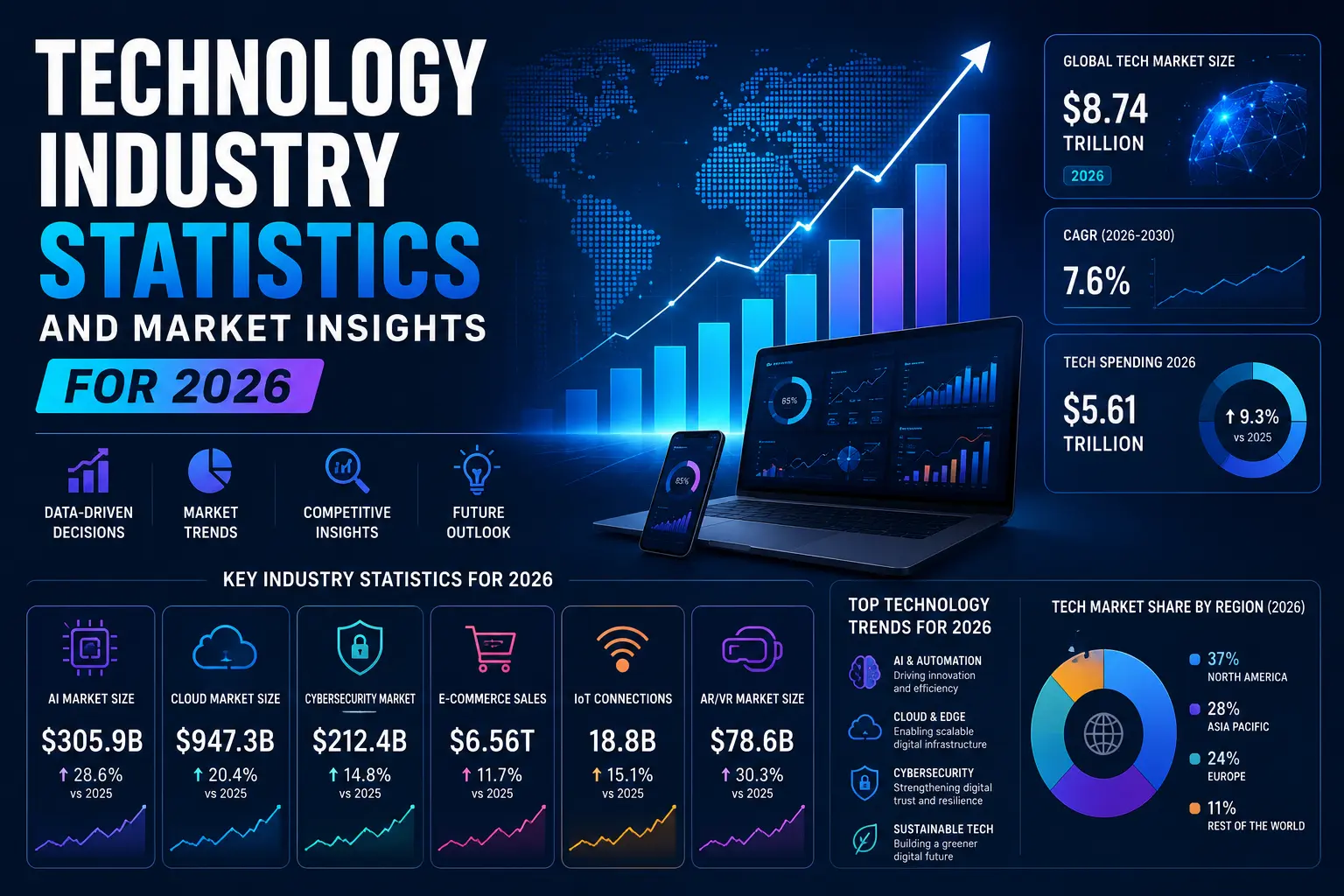
The technology sector in 2026 is defined by a shift from speculative experimentation to focused, value-driven execution. As artificial intelligence moves from simple automation to complex, agent-based workflows, organizations are prioritizing infrastructure reliability, robust governance, and clear return on investment. The industry is no longer just building tools; it is integrating intelligence directly into the fabric of business operations.
Key Growth Drivers in the Tech Landscape
Market momentum is increasingly concentrated in high-performance computing and intelligent systems. The focus has moved away from generalized software deployments toward specialized hardware and agentic platforms that handle autonomous tasks.
-
Semiconductor Expansion: The global semiconductor market is nearing the $1 trillion annual revenue milestone, driven by insatiable demand for AI-specific accelerators, advanced packaging, and custom silicon.
-
The Rise of Agentic AI: A significant shift is occurring where AI systems no longer just provide information but actively perform tasks—such as updating records, managing complex logistics, or routing cross-system requests—without constant human intervention.
-
Edge Computing Proliferation: To minimize latency and enhance real-time decision-making, processing is moving closer to the source of data, becoming a critical requirement for smart cities, autonomous vehicles, and industrial automation.
-
Space-Based Data Centers: The frontier of computation is expanding to orbit, where superior thermal and energy conditions provide a novel environment for training massive AI models.
-
Satellite Connectivity: Direct-to-satellite mobile communication is challenging traditional telecommunications infrastructure, providing connectivity that bypasses terrestrial network limitations.
Strategic Priorities for Tech Executives
As adoption rates for emerging technologies climb, the gap between successful implementation and failed projects has widened. Executives are now focusing on five strategic pillars to ensure their organizations remain competitive.
-
Establishing AI Governance: Organizations are implementing comprehensive frameworks to manage AI risks, including acceptable use policies and human-in-the-loop protocols to verify model outputs and maintain data security.
-
Focusing on Proven ROI: The era of “automation for the sake of innovation” is ending. Companies are prioritizing well-defined workflows, such as customer support or lead enrichment, where AI agents can deliver measurable, double-digit cost savings.
-
Building Resilient Data Architecture: Success with agentic AI depends on seamless integration with existing tools. Leaders are treating data access and cross-system connectivity as the primary bottlenecks rather than the AI models themselves.
-
Cultivating an “AI Elite” Workforce: Rather than planning for broad displacement, successful firms are upskilling their teams, recognizing that human expertise is essential for auditing agent performance and handling complex, non-routine decisions.
-
Strengthening Cybersecurity Posture: With the rise of autonomous systems, the industry is shifting toward zero-trust architectures and quantum-resistant encryption to protect sensitive data at every layer of the enterprise.
Emerging Trends Shaping 2026
Looking beyond standard enterprise software, several technologies are reaching maturity, promising to reshape industrial and consumer standards alike.
-
Humanoid Robotics: Advancements in mobility and cognitive processing are moving humanoid robots from laboratory prototypes to active roles in hospitals, logistics centers, and manufacturing floors.
-
Real-Time Language Elimination: Simultaneous, AI-powered translation via wearable devices is transforming communication, turning foreign language barriers into a minor inconvenience rather than a fundamental obstacle.
-
Autonomous Mobility: Driverless vehicles are operating 24/7 in major metropolitan areas, enabling a fundamental rethink of urban design and public transportation efficiency.
-
Composable Business Platforms: Modularity is the new standard; organizations are adopting flexible, plug-and-play technology stacks that allow them to integrate new solutions without disrupting legacy systems.
Conclusion
The technology industry in 2026 is defined by a clear transition from hype to operational reality. Value is found in the ability to wire intelligent agents safely into existing systems and balance aggressive innovation with rigorous governance. While the pace of change remains rapid, the firms capturing the most value are those that prioritize precise outcomes, human-in-the-loop oversight, and infrastructure stability.
FAQs
1. Why are AI projects failing despite high investment?
Many projects struggle due to vague goals, poor data access, or a lack of internal governance. Success requires connecting AI agents securely to the specific tools where business work actually happens.
2. What is the current state of the semiconductor market?
It is entering a historic phase, with revenues approaching $1 trillion. Growth is fueled by the infrastructure requirements of massive AI data centers and the move toward custom silicon.
3. How is the role of human workers changing in an AI-first office?
Employees are shifting toward roles that involve managing, auditing, and overseeing AI agents. Expertise in verifying AI output and designing high-level workflows is becoming a critical professional competency.
4. What is “agentic AI” and why does it matter?
Agentic AI refers to systems capable of reasoning and acting on behalf of a user to execute complex tasks. It is considered the most significant breakthrough for enterprise efficiency because it automates entire multi-step business processes.
5. How are companies securing their data in an age of autonomous agents?
The industry is moving toward zero-trust architectures, where every action an agent takes is recorded, audited, and strictly confined within the specific permissions granted by an administrator.